If you have spent any time around furniture workshops or interior fit-out sites, you know the request: something that looks like oak. It is the most dependable wood look in the book — warm without turning orange, characterful without shouting, and forgiving enough to sit beside almost any palette. Oak PVC film is how most of that look now reaches the surface, and after years of printing and embossing it, we still enjoy seeing how many directions a single grain can take.
This guide is written from the production side. It covers what oak PVC film actually is, how to pick a tone that will not disappoint on site, where the film earns its keep, and what to check before you commit to a roll or a container.
Content
Strip it back and oak PVC film is a decorated polyvinyl chloride sheet. A print layer carries a photographic oak pattern; an embossing layer adds the pores, cathedrals and fine ridges your fingertips expect; and the base gives the film enough flexibility to be laminated flat, wrapped around a profile, or pressed onto a shaped panel. It is not veneer, and nobody is pretending otherwise. What it does is deliver the visual language of oak at a consistent quality, in repeatable batches, without knots that fall in the wrong place or a colour shift between one board and the next.
Because the grain is printed rather than grown, the same oak pattern can be produced at different gloss levels, different emboss depths and different widths. That flexibility is the real advantage: a kitchen door, a wardrobe carcass and a ceiling beam can all share a family resemblance without anyone having to source a single tree.
Oak sits within our wood grain family, alongside hickory, pine and walnut designs. If you want to see the full breadth of that range first, the collection overview is the easiest place to start.
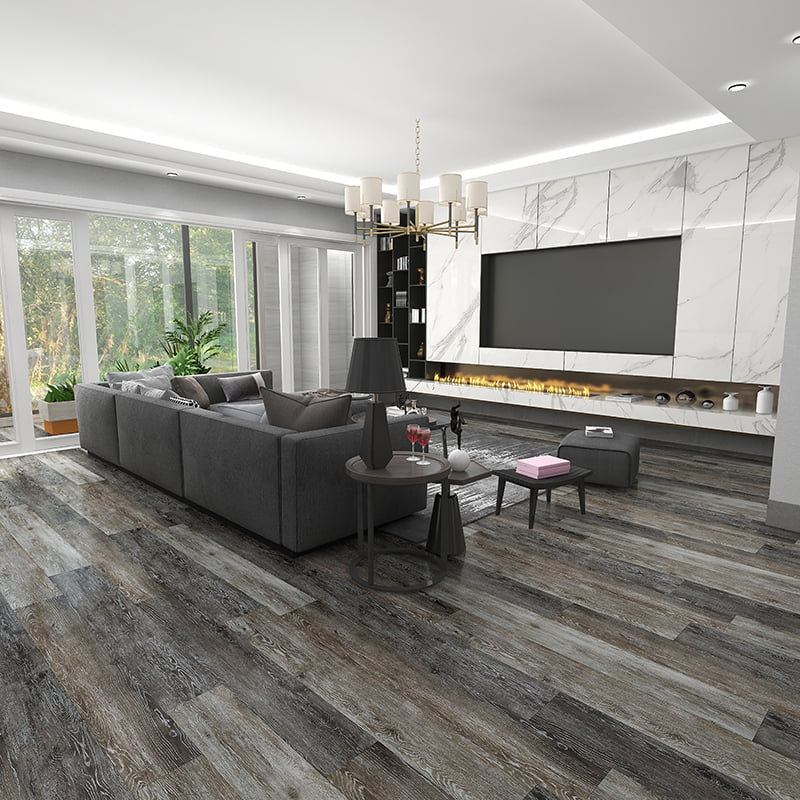 Wood Grain PVC Decorative Film CollectionBrowse the full wood-grain decorative film range, including oak, hickory, pine and walnut designs for indoor floors, walls and furniture.View Product →
Every few years a new texture takes a turn in the spotlight — terrazzo, concrete, rattan-effect weaves — and oak quietly stays on the specification sheet. There are practical reasons for that. Oak grain reads well at a distance and up close, so it suits both large wall panels and small drawer fronts. Its mid-tone value works against white, cream, sage, black and brass, which means a designer can change the accent colour without changing the joinery. And the pattern itself has natural variety: straight grain for calm, sweeping cathedral arches for movement, tight quartered lines for a more formal, architectural feel.
We have written a longer piece on why this particular grain holds its ground, including how it compares with other wood looks — worth a read if you are weighing oak against walnut or hickory.
The word "oak" covers a wide spread of colour, and most disappointment on site comes from a tone mismatch rather than a quality problem. Before samples are requested, decide which direction you are heading.
| Tone direction | What it looks like | Surfaces it suits |
|---|---|---|
| Natural or light oak | Pale straw base, open grain, low contrast | Bedroom furniture, light wall panels, Scandinavian schemes |
| Honey or golden oak | Warm amber, stronger grain contrast | Kitchen doors, dining tables, classic joinery |
| Smoked or fumed oak | Deep brown, muted saturation | Studies, hotel fit-outs, feature doors |
| Whitewashed or grey oak | Washed-back surface, grain still legible | Coastal interiors, retail displays, ceiling beams |
A convincing oak surface depends on registration between the printed pattern and the texture. When the embossed pore lines sit even slightly off the printed pores, the eye notices immediately, even if it cannot say why. Ask for a physical sample rather than a screen image, and check it under both cool and warm light.
Matt finishes read as unfinished timber and hide fingerprints well; low-sheen surfaces are the safe middle ground for furniture; higher gloss suits retail and hospitality where reflection is part of the design intent. Gloss changes the perceived depth of the grain, so a tone approved in matt may look quite different in a sheen finish.
Our oak design range is where most projects begin, and we are happy to send physical swatches so you can compare tones side by side.
Oak Design PVC Decorative Film SeriesCompare oak-look PVC films across multiple models and sheet sizes, suited to furniture and interior panel surfacing with clear, visible grain.View Product →Decoration film is a surfacing material, so it goes wherever a flat or gently shaped panel needs a wood face:
What it is not suited to is heavy wear without protection, prolonged direct heat, or any application where the panel will be cut and left unsealed at the edge. Plan those details before production, not after.
Every factory has its own parameters, and we would rather you test than guess. Still, the sequence is broadly the same everywhere:
Oak PVC film is undemanding. A soft damp cloth with a mild household detergent handles most marks; abrasive creams, scouring pads and solvent-heavy cleaners will dull the surface or attack the print. Wipe spills promptly, keep hot pans and irons off decorative faces, and protect high-traffic edges where impact is likely. Looked after that way, an interior film finish holds its appearance for many years.
Whether you are buying a sample roll or a full production run, a short checklist prevents most disputes:
We are a decorative film manufacturer based in Changzhou, with a second plant in Vietnam that began mass production in September 2023. Our range covers wood, stone and carpet grain families and more than a thousand colourways. If none of the standard oak tones fits your scheme, we can develop a new pattern or shade with you as a special edition — that collaboration is one of the more interesting parts of the job. Visitors are welcome at the factory, and you can read more about how we work on our company profile page.
Send us the surface you have in mind, the tone you are aiming for, and the process you will use. We will tell you honestly which oak film suits it, and which one does not.



Contact
 China Company Address: No.5 Zhaojia Road,
Vietnam Factory Address: GNP Yen Binh
1 - lndustrial Center (Lot CN13,CN18,Yen
Binh Industrial Park, Ward, Dng Tien, Ph8 Yen,
Thai Nguyen 24000)
Thailand Factory Address: 289/12 Moo 7, Klong Kiu Sub-District, Ban Bueng District, Chonburi 20220 THAILAND
 Tel: +86-13685281168
+86-13813687178
 E-mail: [email protected]




 English
 русский