Content
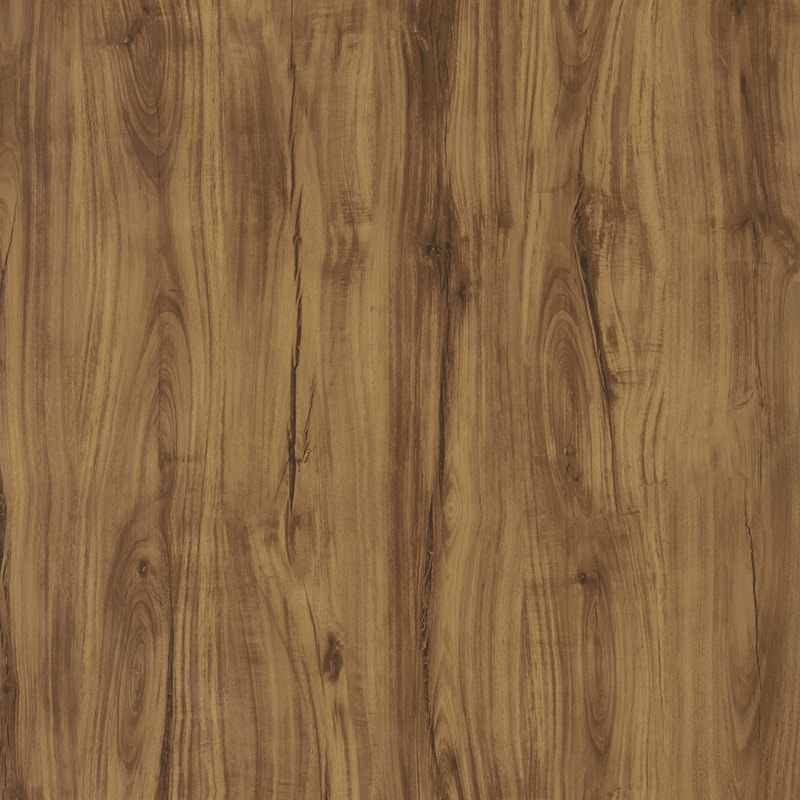
Walnut decorative film is a surface covering material that replicates the appearance of real walnut wood — its grain pattern, color depth, and texture — without using any actual timber. The film is manufactured in layers: a printed decorative layer carrying the walnut grain image, a protective topcoat that determines surface finish and durability, and a backing layer that is either a pressure-sensitive adhesive for self-adhesive versions or a plain substrate for heat-activated and lamination applications.
The core substrate is most commonly PVC (polyvinyl chloride), though paper-backed and polyester-backed versions exist for specific applications. PVC-based walnut wood grain film dominates the furniture, cabinetry, and interior fit-out markets because PVC handles embossing well — the surface texture that gives the film its tactile resemblance to real wood grain — and because PVC is dimensionally stable across the temperature and humidity ranges typical of interior environments.
What walnut decorative film is not is a structural material or a wood veneer. Real walnut veneer is a thin slice of actual walnut timber, typically 0.3mm to 0.6mm thick, that carries the natural variation of real wood. Decorative film is a printed and embossed reproduction. A high-quality walnut finish film can be visually convincing at normal viewing distances, but it won't have the natural grain variation of real veneer, and it won't respond to finishing products like stains or oils the way real wood does. Understanding this distinction upfront prevents misapplication and mismatched expectations.
Not all walnut decorative films look the same, and the grain pattern is the most significant visual variable. Real walnut timber produces several distinct grain figures depending on how the log is cut, and quality film manufacturers reproduce these patterns in their product lines. Knowing which pattern suits the application prevents sourcing the wrong visual result.
Straight grain walnut film reproduces the clean, parallel grain lines of flat-sawn or rift-sawn walnut. This is the most versatile pattern — it reads as calm and contemporary, works with both modern minimalist and transitional interiors, and tiles seamlessly across large panel surfaces without creating obvious repeat lines. It is the most widely specified walnut film pattern for furniture fronts, kitchen cabinetry, and wall paneling.
Crown grain walnut film features the arching, cathedral-like grain pattern produced by plain-sawn cuts through the center of the log. The characteristic arch peaks at the center of each board width and sweeps outward toward the edges. This pattern has more visual movement than straight grain and is associated with a more traditional or warm aesthetic. It is commonly used in furniture panels, door skins, and decorative wall applications where visual richness is a priority over seamless surface uniformity.
Figured walnut film reproduces the irregular, swirling grain patterns found in burled, crotch-cut, or highly figured walnut timber. These patterns are rare and expensive in real veneer, which makes the film version particularly cost-effective for applications where a premium visual effect is desired. Figured walnut decorative film is used in high-end furniture accents, automotive interior trim, and luxury fit-out applications where the goal is maximum visual impact on feature surfaces.
Walnut wood grain film can be applied to a wide range of substrates, but adhesion performance varies significantly depending on the surface type, its condition, and the adhesive system used in the film. Applying film to an incompatible or improperly prepared surface is the leading cause of edge lifting, bubbling, and premature failure.
| Substrate | Compatibility | Notes |
| MDF / Particleboard | Excellent | Ideal substrate; smooth, stable, absorbs adhesive well |
| Plywood | Good | Sand surface smooth; grain telegraphing possible on thin film |
| Painted Wood / MDF | Good | Paint must be fully cured, clean, and free of flaking |
| Metal (steel, aluminum) | Good | Degrease thoroughly; use primer for powder-coated surfaces |
| Glass | Good | Clean with isopropyl alcohol; edges need sealing to prevent moisture ingress |
| Raw / Oiled Wood | Poor | Oil contamination prevents adhesion; must seal surface first |
| Textured Surfaces | Poor | Film bridges texture peaks; bubbling and lifting at low points |
| Silicone-treated surfaces | Incompatible | No adhesive system bonds reliably to silicone |
Surface preparation is not optional — it is the most important step in the application process. Even a high-quality walnut adhesive film will fail on a dusty, greasy, or poorly cured surface. Before application, clean all surfaces with isopropyl alcohol, allow full evaporation, and inspect for any surface contamination, loose paint, or irregularities that would need to be filled or sanded before film goes down.
The adhesive system in a walnut decorative film determines repositionability, final bond strength, removability, and suitability for different application environments. Choosing the wrong adhesive type for the application — particularly in high-humidity or high-heat environments — is a frequent cause of film failure that has nothing to do with the film's print or surface quality.
Permanent PSA walnut film is the standard choice for furniture, cabinetry, and fixed interior surfaces where the film is intended to stay for the life of the installation. The adhesive activates on contact with pressure and reaches full bond strength within 24 to 72 hours of application. It offers strong resistance to edge lifting in humid environments and is the most widely available adhesive type across film grades. Removal is possible but typically requires heat application and leaves adhesive residue on the substrate.
Repositionable walnut wood grain film uses a lower-tack adhesive that allows the film to be lifted and repositioned during application without tearing or losing adhesion. This makes it significantly easier to apply on large panels without trapping air bubbles. Once in final position and firmly pressed down, it develops adequate long-term bond strength for interior applications. It is not recommended for high-humidity environments such as bathrooms or kitchens near steam sources, where the lower initial tack can allow moisture-driven edge lifting over time.
Heat-activated walnut decorative film — common in membrane pressing and vacuum forming processes used in professional furniture manufacturing — requires an elevated temperature (typically 90°C to 130°C) to activate the adhesive and conform the film to the substrate. This method is used for profiled surfaces, routed edges, and three-dimensional shapes that self-adhesive film cannot conform to without wrinkling. Heat-activated film is primarily a trade product and not suited to hand application.
Applying walnut finish adhesive film cleanly on a flat panel is a learnable skill, but it requires patience and the right sequence. The two most common failure modes — trapped air bubbles and lifting edges — are both preventable with proper technique.
Walnut decorative film is used across a wide range of interior and furniture applications, and its versatility is one of its primary commercial advantages. The same film that wraps a kitchen cabinet door can be used on a retail display unit, an office partition, or a residential wall panel — the application method and substrate preparation vary, but the material is the same.
The price range for walnut decorative film is wide, and the quality difference between the top and bottom of that range is significant enough to affect the appearance and longevity of any application. Understanding what drives quality differences helps buyers evaluate products before committing to a large order.
Budget walnut films are often printed at lower resolution with a limited number of repeat panels before the pattern cycles — which means visible, regular repeats across large surface areas. Quality walnut wood grain film uses high-resolution gravure or digital printing with long pattern repeats (often 1.2 meters or more before the pattern cycles) that eliminate the artificial regularity that makes cheap film look fake at close range. Some premium films use multi-layer printing to add depth and tonal variation that more closely mimics the way light interacts with real wood grain.
High-quality walnut decorative film uses registered embossing — the physical texture on the film surface is mechanically aligned with the printed grain pattern so that the raised texture follows the grain lines in the print. This synchronization is what makes premium film feel like it looks. Budget film uses a generic emboss pattern applied independently of the print, which creates a misalignment between what you see and what you feel — a detail that's immediately noticeable when running a finger across the surface.
The protective topcoat determines how the film holds up to daily use. Key performance indicators include abrasion resistance (measured in Taber abrasion cycles), scratch resistance, chemical resistance to common household cleaners, and UV stability. Request technical data sheets from suppliers and compare abrasion ratings — quality walnut finish film for furniture applications typically achieves 150 to 500 Taber cycles at 1kg load; budget alternatives often fall below 100 cycles, which translates to visible wear on frequently touched surfaces within one to two years.
Total film thickness for furniture-grade walnut decorative PVC film typically runs between 0.18mm and 0.35mm. Thinner films are more prone to telegraphing substrate imperfections and tearing during application around edges. Thicker films are more forgiving to apply, wrap edges more cleanly, and provide better impact resistance in use. Confirm total thickness (not just PVC layer thickness) from the supplier's technical documentation, as some manufacturers quote base substrate thickness while omitting the adhesive layer from the stated figure.



Contact
 China Company Address: No.5 Zhaojia Road,
Vietnam Factory Address: GNP Yen Binh
1 - lndustrial Center (Lot CN13,CN18,Yen
Binh Industrial Park, Ward, Dng Tien, Ph8 Yen,
Thai Nguyen 24000)
Thailand Factory Address: 289/12 Moo 7, Klong Kiu Sub-District, Ban Bueng District, Chonburi 20220 THAILAND
China Company Address: No.5 Zhaojia Road,
Vietnam Factory Address: GNP Yen Binh
1 - lndustrial Center (Lot CN13,CN18,Yen
Binh Industrial Park, Ward, Dng Tien, Ph8 Yen,
Thai Nguyen 24000)
Thailand Factory Address: 289/12 Moo 7, Klong Kiu Sub-District, Ban Bueng District, Chonburi 20220 THAILAND
 Tel: +86-13685281168
+86-13813687178
Tel: +86-13685281168
+86-13813687178
 E-mail: [email protected]




 English
 русский